Balochistan carnage
AI Summary
The security situation in Balochistan, Pakistan, is deteriorating due to increased terrorist violence by groups such as the TTP and BLA, resulting in numerous casualties among security forces and civilians. Military and civilian leadership emphasize kinetic action against terrorists and a political solution addressing socioeconomic inequities to restore peace.
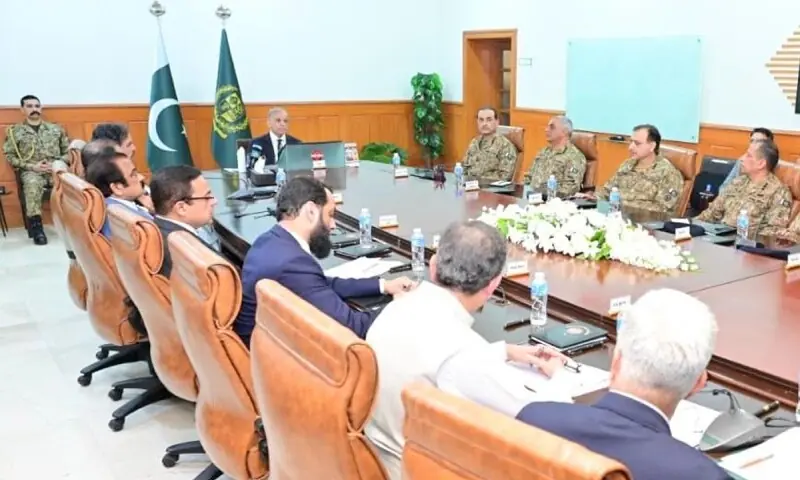
THE security situation in Balochistan remains alarming, with a recent uptick in terrorist violence resulting in a large number of casualties amongst security forces. The seriousness of the situation can be gauged from the fact that the country’s top civilian and military leaders — led by the prime minister and chief of defence forces — were in Quetta yesterday to take stock of matters. On Tuesday, the ISPR chief, while addressing the media, discussed law and order issues in the province, mentioning that a large number of security personnel and civilians had lost their lives in separate attacks since July 5. The martyred included four civilians in Hanna Urak, at least 27 policemen in Ziarat, and 11 soldiers in Bela-Winder. A number of terrorists were also eliminated in retaliatory operations. The military says the banned TTP was responsible for the Ziarat outrage while the proscribed BLA was behind the Bela ambush. The ISPR chief, while indicating the state would give no quarter to terrorists, also pointed out that hostile foreign forces were involved in Balochistan’s violence. While speaking at the National Defence University, the CDF similarly indicated the involvement of “state-sponsored … hostile intelligence agencies” in destabilising Pakistan. The recent violence illustrates the fact that two ideologically very different terrorist groups — the religious extremists of the TTP, and the separatists of the BLA — are responsible for the bloodshed in Balochistan. Any linkages between these violent actors must be probed and their nexus dismantled by the state. Moreover, the involvement of India and Taliban-ruled Afghanistan needs a response through diplomatic channels, so that all hostile foreign forces desist from their destabilising behaviour. Pakistan has taken kinetic action against the Taliban for their support to the TTP, while Indian involvement in Balochistan has been previously exposed as well. Yet while kinetic action is essential to restore the writ of the state and destroy the terrorist infrastructure, the long-term solution to Balochistan’s problems remains the political path. The province’s opposition leader has highlighted the need for a “serious political strategy”, while a recent multiparty moot in Islamabad stressed the need for a political solution. While those that threaten the integrity of Pakistan and refuse to give up violence must be dealt with on the battlefield, the door to those who pledge to respect the Constitution and struggle through non-violent means for Balochistan’s rights must not be closed. A viable dialogue and political process involving Baloch nationalists and other stakeholders with roots in the province is essential to bring peace to Balochistan. The state must also address the province’s socioeconomic problems fairly and transparently, as entrenched poverty and inequality in Balochistan only serves to attract more recruits to the terrorists’ ranks. Published in Dawn, July 10th, 2026