Chilling effects of Trump’s war on free speech extend far beyond campus walls – and that’s the point
AI Summary
A chilling effect is reported across U.S. college campuses where student activism has significantly declined due to fear stemming from the Trump administration's strict policies. This atmosphere of self-censorship extends beyond students to professors, researchers, and media, illustrating widespread societal restraint.
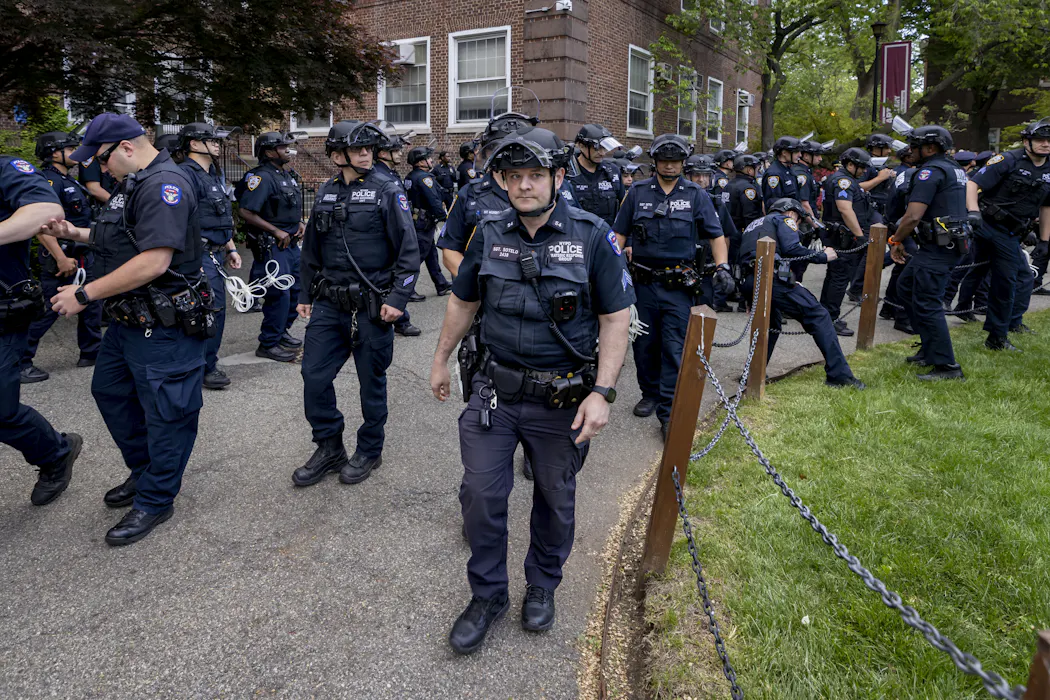
Police clear the campus of Brooklyn College on May 8, 2025, after students established an encampment to protest the Gaza war. Michael Nigro/Pacific Press/LightRocket via Getty Images Younger Americans have soured on the second Donald Trump presidency, but they are not protesting it. Despite an unpopular Iran war and an even more unpopular Trump administration, college campus protests nationwide have gone silent. And at many schools, student activism is virtually nonexistent. This silence comes in the wake of a relentless Trump administration war on campus speech that has involved lawsuits, arrests, deportations and expulsions. Reports cite a range of complicated factors for the restraint, from apathy to technology-induced incapacity. But as public policy and law and social science experts, we believe students aren’t protesting for a very simple reason: They are afraid. They are self-censoring and disengaging from campaign activism to avoid punitive measures. In law and social science, we call this impact a chilling effect – the behavioral tendency for people in face of a threat to self-censor and restrain their activities for self-protection. It’s increasingly clear to us that these impacts are not incidental or ancillary to Trump administration policy. Rather, the chilling effects are the point. This is the closest thing to a consistent governing strategy in Trump’s second term. The broader chill of Trump threats Chilling effects can be subtle, but today they are everywhere. And it’s not just students who are chilled by Trump administration threats. Professors are censoring themselves in lectures and rewriting syllabuses. Researchers are stripping grant applications of words that might attract federal scrutiny, or abandoning the topics entirely. Media outlets are modifying their news coverage to avoid Trump lawsuits or sanctions. Law enforcement and regulatory agencies are refusing to investigate Trump-aligned actors inside or outside government, and major national law firms are declining cases challenging Trump administration policies. Publishers are “stepping back” from LGBTQ+ books and other progressive subjects. Many in targeted immigrant communities are afraid to leave home to go to work or school. In most cases, these people and institutions are not being specifically targeted or threatened by Trump. But they are afraid, and their fear is doing the administration’s work for it. They stay silent, avoid attention and confrontation, and look the other way. In other cases, they change their speech and behavior to accommodate or conform to the administration’s worldview. Of course, there are counterexamples, such as the winter protests in Minneapolis in response to brutality by agents with U.S. Immigration and Customs Enforcement, and the recent “No Kings” rallies. But even here, the broader but less visible trend – chilling effects – is evident. Minneapolis police officers arrest and scatter protesters on the campus of the University of Minnesota in Minneapolis on Feb. 5, 2026. Richard Tsong-Taatarii/The Minnesota Star Tribune via Getty Images For instance, in recent reporting on the latest No Kings rallies, many media outlets observed that students were noticeably missing, despite the Trump administration’s unpopularity among younger Americans. A persistent strategy We believe none of this is by accident. In a new book, “Chilling Effects: Repression, Conformity, and Power in the Digital Age,” one of us – Jon Penney – explains how law, technology, and state and corporate power are weaponized to chill and repress, and the dangers this poses for the United States and other democratic societies. The other – Bruce Schneier – has extensively studied the security infrastructure enabling this. What we see isn’t gratuitous government cruelty, chaos or vengeance. Instead, we see a persistent strategy to maximize fear and chilling effects in ways that are corrosive to freedom and democracy. Research suggests that surveillance, personal threats, uncertainty and abuse of power are key factors in doing so. The federal government has a clear and systematic pattern of employing these very mechanisms across a number of domains far beyond campuses. They are evident in militarized raids by Immigration and Customs Enforcement and in journalists being arrested and indicted for reporting on protests. They are made clear in the long list of political enemies the Trump administration has investigated or threatened, including the Federal Reserve chairman. And they can also be seen in the weaponization of technology, including ramping up surveillance to target critics and protestors. Corrosive to freedom and democracy History offers some guidance on impacts. During the McCarthy era, overreaching laws, surveillance, and public and private sector reprisals ostensibly targeted alleged communists. But the real aim was often to suppress progressive journali