How a tiny Caribbean island made American independence possible
AI Summary
St. Eustatius, a small Dutch Caribbean island, played a crucial role in the American Revolution by serving as a vital trading hub. Its deep port and strategic location enabled the Continental Army to access arms and supplies, supporting the 13 colonies' fight for independence.
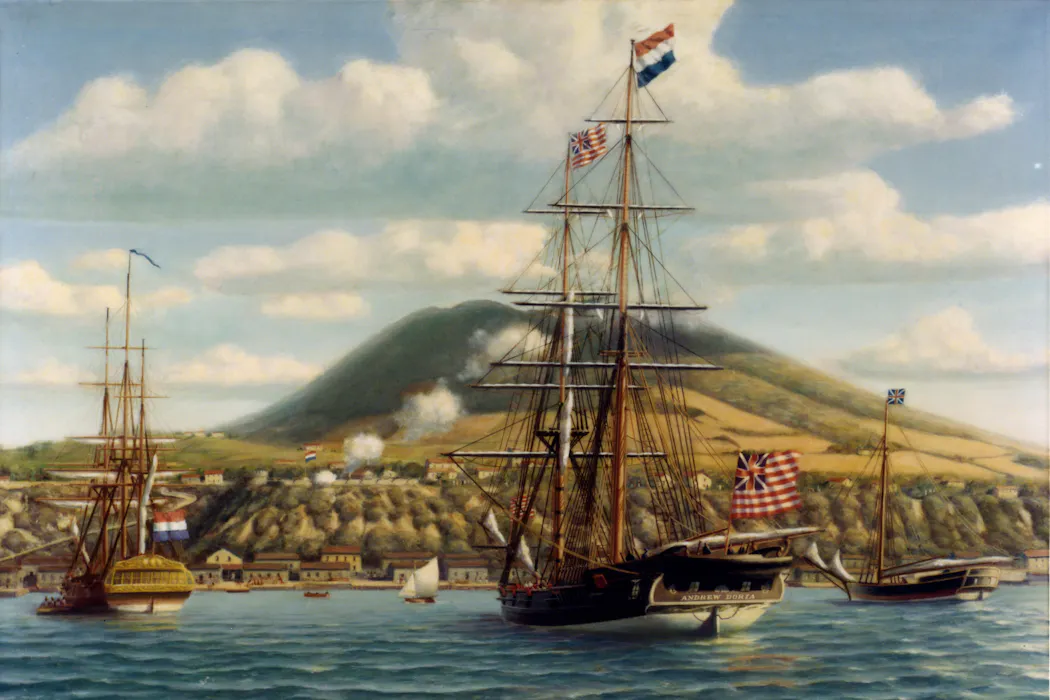
On Nov. 16, 1776, the Andrew Doran, coming from the fledgling United States, was acknowledged with the firing of a cannon from St. Eustatius. This event is now known as the 'First Salute.' Painting by Phillips Melville, USMC (Retired) via Wikimedia Commons The American Revolution is often told as a heroic story of 13 colonies rising up against a mighty empire and, with some help from France, winning their independence. But the real story is more complicated. As the United States approaches the 250th anniversary of its independence, it is worth remembering that success on the battlefield depended not only on courage and ideals, but also on trade, credit, shipping and access to military supplies. The center of that trade was not the 13 Colonies – but south of Loyalist Florida, in the greater Caribbean. Here developed the center of the Atlantic economy due to the insatiable appetite for sugar that had grown across Europe by the late 1700s. The economic output of just Jamaica was the same as the entire 13 Colonies. The Caribbean economies depended on slave labor, trade and supplies from around the world to make sure the sugar flowed freely and tax revenues to European colonial powers were maximized. Much of that support flowed through a small Dutch island in the eastern Caribbean that few Americans know today: St. Eustatius. Small but mighty I’m a historical archaeologist, and for eight years earlier in my career, I lived on St. Eustatius and served as island archaeologist and founding director of the St. Eustatius Center for Archaeological Research. Barely 8 square miles (about 21 square kilometers) in size, St. Eustatius – or as residents call it, Statia – sits to the northwest of St. Kitts and Nevis. Without this tiny island, the Continental Army might have found itself without the arms, gunpowder and the supplies it needed to survive. Statia’s importance began with geography. The island rises steeply from the blue waters of the Atlantic and Caribbean. Its dormant volcano, known as the Quill, dominates the southern part of the island. Unlike taller Caribbean islands, Statia did not receive enough rainfall to make it especially attractive for large-scale sugar production. That made it less valuable to the great sugar powers of the 18th century, especially Britain and France. What Statia lacked in plantation potential, it made up for as a port. Oranje Bay, on the western side of the island, offered one of the deepest and safest nearshore anchorages in the Americas. Large merchant ships could come close to shore, unload their cargo and reload quickly. Along the bay stood a long, busy waterfront, lined with warehouses, shops and trading houses. By the mid-18th century, this narrow strip of shoreline had become one of the most important commercial centers in the Atlantic world. Imperialism through trade The Dutch had settled St. Eustatius in the 1630s, around the same time they were developing New Amsterdam, now New York City. Dutch merchants, families and investors moved through a wide Atlantic network that connected Europe, Africa, the Caribbean and North America. These commercial ties created trust, credit and opportunity across long distances. In the 17th and 18th centuries, European empires tried to control colonial trade through mercantilism. Colonies were expected to enrich the mother country by supplying raw materials and buying finished goods through approved channels. Taxes, tariffs and trade restrictions benefited imperial governments and favored merchants, but they raised costs for ordinary colonists, shopkeepers and planters. British colonists in North America often resented these restrictions, but Dutch traders were willing to help them get around them. For generations, Dutch vessels carried goods throughout the Atlantic, often selling items at lower prices than British merchants could offer legally. Archaeological evidence from sites such as Pope’s Creek Plantation in Virginia, the Washington family home, shows the presence of Dutch ceramics, clay pipes and yellow bricks. Even before the Revolution, Dutch trade was woven into colonial life. ‘The emporium of the world’ In 1754, the Dutch West India Company petitioned the Dutch government to make Oranjestad, the capital of St. Eustatius, a free port, and the request was granted. The result was extraordinary: Goods could move through the island with few restrictions and without the heavy taxes common elsewhere. The government profited from leases on land, warehouses and homes rather than from taxing every cargo. Merchants from across the Atlantic world quickly took advantage. Ships arrived carrying textiles, tools, food, enslaved people, weapons, luxury goods and raw materials. Languages from Europe, Africa and the Americas could be heard in the streets. St. Eustatius became, in the words often associated with the island, “the emporium of the world.” In modern terms, it functioned like an Amazon fulfillment center for the 18th-century Atlantic. Adam