Pakistan warns Houthi rebels to steer clear of its ships
AI Summary
Pakistan has issued a strong warning to the Houthi rebels against attacking its ships, deeming any such aggression a direct attack on the nation. Pakistan reassures Saudi Arabia of its support and vows to work together to maintain maritime security in critical chokepoints such as Bab el-Mandab.
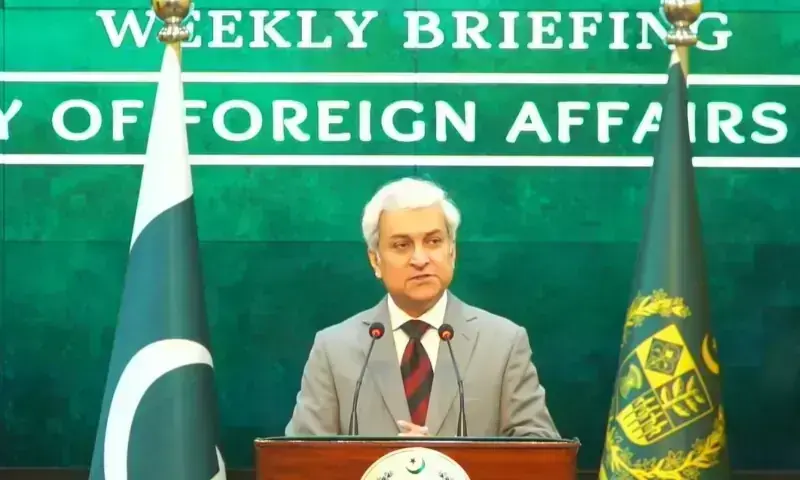
• Says armed forces vigilant about situation in Bab el-Mandab; will give swift response if Islamabad’s assets come under attack • PM reassures Saudi crown prince of full support, condemns Yemeni rebels’ attacks on oil tankers • Dar meets Omani FM on sidelines of Asean moot; FO says efforts on to secure de-escalation ISLAMABAD: Pakistan on Thursday doubled down on its warning to Yemen’s Houthi rebels, describing any attack on its maritime interests as a “red line” and declaring that such a strike would be treated as an attack on the country, while simultaneously reassuring Saudi Arabia of its support and pledging to work with Riyadh to ensure the uninterrupted flow of ships through the Bab el-Mandab chokepoint. At his weekly media briefing, Foreign Office spokesperson Tahir Andrabi left little room for ambiguity about Islamabad’s position. “I do not think that there is a thin line when it comes to defending our national security and our assets. This is not a thin line; this is a red line. This red line is strictly within the context of our own national security,” he said, adding that any attack against Pakistani flagged vessels or commercial ships belonging to the country “will be treated as an attack against Pakistan and will be met with a swift response in the exercise of our right to self-defence’’. He said the determination of what constituted a threat or an attack would remain a technical assessment to be made by Pakistan’s armed forces, which would remain vigilant in the area. The spokesperson further reaffirmed that Islamabad remained fully committed to all bilateral agreements with Saudi Arabia, including a mutual defence arrangement that had been duly concluded and ratified. Pakistan had last year signed a defence pact with Saudi Arabia, according to which any attack against one country will be considered aggression against both. The remarks came hours after Prime Minister Shehbaz Sharif spoke by telephone with Saudi Crown Prince and Prime Minister Mohammed Bin Salman, during which he condemned in the strongest terms the Houthi attacks on Saudi oil tankers in the Red Sea, describing them as unacceptable, a violation of international law and a threat to freedom of navigation, commercial shipping and regional peace and stability. The prime minister reiterated Pakistan’s unwavering support for the Kingdom’s security, sovereignty, territorial integrity and prosperity, and assured the crown prince that Islamabad would continue working closely with Saudi Arabia and the international community in support of peace, security and the uninterrupted flow of lawful maritime commerce through the Red Sea, the Strait of Hormuz and adjoining waters, according to a statement issued by PM Office. Pakistan’s latest warning follows FO’s condemnation a day earlier of Houthi threats against Saudi Arabia and commercial shipping after the group announced on July 20 an immediate maritime embargo against the Kingdom, portraying the move as retaliation for what it called the longstanding Saudi led siege of Houthi controlled ports and airports and a recent strike on Sana’a airport. De-escalation in Mideast The Foreign Office spokesperson also indicated that Pakistan remained committed to efforts aimed at de-escalating the conflict in the Gulf despite the setbacks suffered by the peace process. Andrabi said Islamabad had not abandoned hope that the two sides could eventually return to negotiations even as military operations continued. “Pakistan has been advocating for peace and the necessity of giving peace a chance through diplomacy and dialogue. We believe that the best template to revert to the peace process remains the Islamabad MoU and the Joint Statement between Pakistan and Qatar, which offers a roadmap for implementing this peace process,” he said. His remarks came as Pakistan continued consultations with key regional countries involved in mediation efforts. Deputy Prime Minister and Foreign Minister Ishaq Dar met Omani Foreign Minister Sayyid Badr Al Busaidi on the sidelines of the Asean Regional Forum in Manila, where the two leaders reviewed the latest regional and international developments. According to FO, the two ministers expressed concern over the recent deterioration in the security situation, underscored the importance of preserving the ceasefire, respecting international law and working towards lasting peace and stability in the region. “We have not lost hope. We had not lost hope in the darkest days of this conflict cycle, when escalations mounted and there were armed attacks back and forth. Even then, we were not discouraged. We remain hopeful, however grim the situation may be on the ground. It is with the same degree of optimism that we will carry forward our advocacy for dialogue and diplomacy,” Andrabi added. GSP+ report and Amnesty claims The FO spokesperson, meanwhile, expressed disappointment with the European Union’s latest assessment of Generalised Scheme of Preferences implementation, saying