The fightback in Bandung and Pakistan football’s reality
AI Summary
Pakistan came from two goals down to draw 2-2 with the Philippines in the FIFA ASEAN Cup, earning its first point and scoring its first goal in a FIFA competition. The article highlights the achievement despite Pakistan’s limited preparation, absent head coach and weak domestic football infrastructure.
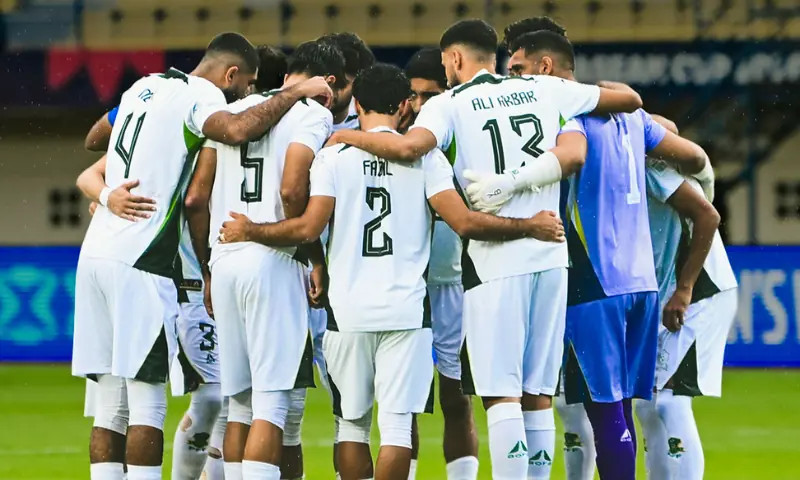
When Abdul Samad Arshad cut in past a Philippines defender before shooting the ball along the ground to beat the goalkeeper on Tuesday, it was a moment of disbelief for the Pakistan fans — those in small numbers at the Si Jalak Harupat Stadium in Bandung, Indonesia, and those watching on screens back home and around the world. The shot — now etched in Pakistan football history as the one that brought the side its first ever point in a FIFA competition, the FIFA ASEAN Cup, and against a side ranked more than 60 places above it — equalled the scores to 2-2 after Philippines had scored two early, and sparked celebrations in equal measure. The delight was special because it came with a surprise element. How could a team that had prepared for the tournament in a short training camp, without its head coach, stun a higher-ranked side in this manner? How could a team from a country without even a semblance of a proper football competition and grassroots structure challenge one from a country that has all of that and more? And how could a federation beset by a prolonged crisis field a side so competitive? Those questions are almost as important as the result itself. Samad provided one answer. The Pakistan player based abroad had arrived in Indonesia on Sept 25, a day before the team’s opening FIFA ASEAN Cup match against Thailand, which Pakistan lost 4-0. Several of his fellow diaspora players also joined the squad directly in Indonesia rather than being part of the national-team camp in Islamabad. The camp itself was brief. And head coach Nolberto Solano was not there. The Peruvian coach missed the camp after applying for the wrong type of Pakistan visa. His documents had to be resubmitted, delaying his arrival until the team was already in Indonesia. In his absence, assistant coaches Titus Bramble and Walid Javaid oversaw the sessions. For a national team whose players largely do not play together, those lost days matter. Yet two days after Samad arrived, Pakistan were back on the pitch against the Philippines and, after falling 2-0 behind, produced the sort of comeback that had rarely been seen from the national side. Mohammad Ali Akbar pulled one back two minutes after half-time before Samad equalised around the hour. Pakistan had never previously scored in, or taken a point from, a FIFA competition. They had now done both in the same match. “This is a fantastic result for Pakistan football, arguably its most impressive result of the 21st century,” Ismail Farooq, a football analyst at FC Nuremberg in Germany and a keen observer of Pakistan football, tells Dawn. Ismail puts the achievement into perspective by pointing to the gulf between the two teams. Pakistan are ranked 198th in the world while the Philippines are around 60 places higher and have the kind of regular domestic football and established structures that Pakistan have lacked. Pakistan, he said, were “massive underdogs”. That makes the fightback significant. But it also makes what happened before it harder to ignore. The players arrived from different parts of the world, trained together for a limited period and entered the tournament without having had the benefit of a full camp under their head coach. The result therefore says as much about the resilience of the players as it does about the possibilities that exist within Pakistan’s player pool. It is also where the country’s diaspora footballers become part of a much larger conversation. The overseas-based players have increasingly provided Pakistan with a pool of talent that would be difficult for the domestic system to produce on its own. But their late arrival also highlights the absence of a sufficiently strong structure at home to prepare and develop players consistently. Shaikh Hamdan, head coach of Karachi United Football Club and a UEFA B-licensed coach, believes the result could nevertheless have an important effect well beyond the national team. “Any positive result for Pakistan football can only be a good thing for the game at grassroots level,” he tells Dawn. “Results inspire participation.” Children watching Pakistan score and compete, he added, could begin to dream of representing the country, while positive performances could also help convince parents that football can be more than simply a recreational pursuit for their children. That is the opportunity presented by Bandung. But it is not the same as having a functioning football system. Pakistan have not had a proper domestic league since 2015. Youth competitions remain limited and competitive opportunities for young players are scarce. There is no consistently functioning pathway taking a talented child from grassroots football through age-group competitions and into the professional and international game. “There are passionate coaches, academies and football communities doing excellent work across the country,” Hamdan says. “But there is still no structured pathway that consistently takes talented young players from grassroots