WHAT NEXT FOR THE GULF?
AI Summary
The article discusses the halted US-Iran conflict and its impact on the Gulf region, including economic and food security consequences due to the Strait of Hormuz blockade. It highlights the changed geopolitical landscape and the challenges of establishing a new regional order post-conflict.
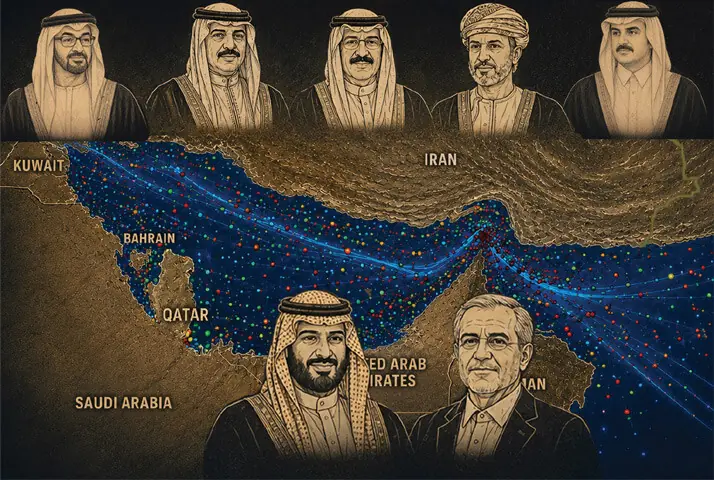
An illustration showing (top, left to right) the President of the United Arab Emirates (UAE) Sheikh Mohamed bin Zayed Al-Nahyan, Bahrain’s King Hamad bin Isa Al-Khalifa, Kuwait’s Emir Sheikh Mishal Al-Ahmad Al-Jaber Al-Sabah, the Sultan and Prime Minister of Oman Haitham bin Tariq Al-Said, Qatar’s Emir Tamim bin Hamad Al-Thani, (and bottom) the Crown Prince of Saudi Arabia Mohammed bin Salman and Iranian President Masoud Pezeshkian over a map of the Gulf with pre-war ship locator markings showing ships travelling via the Strait of Hormuz FOREWORD The United States-Zionist war of aggression on Iran has been partially halted by a Memorandum of Understanding (MoU). Given the rising cost-exchange ratio because of Iran’s response, US President Donald Trump was looking for a deal. He admitted to the media at the G-7 summit that he “did not want to be the late, great Herbert Hoover”, the president historically blamed for the onset of the Great Depression. Trump also made plain that continuing the war meant global recession. He started a wrong war. But he is right about ending it. The blockade of the Strait of Hormuz nearly paralysed a massive ecosystem of oil and gas and petroleum derivatives and byproducts. Food security was affected because fertiliser strangulation hit farming sectors in the region and beyond at several critical pressure points. The blockade bottlenecked shipping lanes for vital agricultural commodities. Prices were skyrocketing. The global agri-food system was being threatened to a point where the United Nations Food and Agriculture Organisation (FAO) warned of a “catastrophe”. Polls in the US showed the war was deeply unpopular. Trump’s ratings have plummeted. With the Congress up for grabs, the war with Iran was becoming a highly toxic liability for the Republican party ahead of the November elections. Having failed at achieving all the changing and stated objectives of the war, there were no real, military-operational options left with Trump, short of unleashing aimless destructive savagery that would push the region, already teetering on the brink, over the cliff. Iran, for its part, while taking and absorbing the pain, was prepared to accept the cost of waiting and forcing Trump to blink. He did. What next now? The war launched on Iran by the US and Israel has, among many other things, irreversibly transformed the Gulf’s strategic landscape. It appears that the old security paradigm has collapsed and, much as the US might wish, the situation cannot revert to the pre-war status quo ante. But can an inclusive regional order emerge in its place? BACK TO BUSINESS? The MoU addresses the immediate situation and tries to take immediate pressure off the US, Iran and the Gulf states, but it does not, cannot, address the structural reasons for the almost five-decade-long conflict that has defined relations between Iran and the US and Iran and the Zionist entity. And if we throw in the Palestinian conflict, in many ways central to the broader conflict in the Middle East, we are talking about a century. In many ways the two have become inextricably linked. Second, while the US and the Zionists attacked Iran together, any deal, partial or full, between Iran and the US has to be treated separately from the conflictual bind in which the Middle East finds itself because of land, rights and dignity stolen from the Palestinians. Three, parsing the issues requires narrowing the focus here to analyse the geopolitics of the Gulf: there was a pre-war Gulf and there’s a post-war Gulf and a gulf separates the two. Four, the war was an inflection point, though change won’t come overnight. The US as the net security provider in the Gulf is not about to relinquish that role, tied in as it is with its core interests. The Zionist regime thrives on perpetual conflict with the help of the US and will not change course, even as it will make minor tactical adjustments in its strategy, in deference to US sensitivities at particular moments. That leaves the Gulf Cooperation Council (GCC) states. They partnered with the US and provided it bases to act as a counterweight to Iran and enhance their security. The quid for the quo was to ensure global energy security and to become an investment and development hub by diversifying fossil-fuel-based economies. Iran’s retaliation against those bases and critical infrastructure has exposed the structural-geographic flaw in that approach. What are their choices now? They can’t stay the old course. How do they think anew? There are three options. Treat Iran as an inveterate foe; figure out a security and/or cooperative framework that is inclusive of Iran; or find a median — keep their relationship with the US but also remain verifiably neutral in any future US-Zionist-Iran conflict, a position somewhere between being actively in the anti-Iran camp and pulling Iran into the GCC tent. Whatever course the GCC might take would require us to deconstruct the history of institutional fr