What triggered the plunge of K2 flight
AI Summary
K2 Airways Flight 1732 crashed into the sea following a rapid descent caused by a reported navigation system failure. Investigations consider IRU failure, spatial disorientation, and crew resource management breakdown as primary causes amid potential GPS spoofing and nearby military conflict risk.
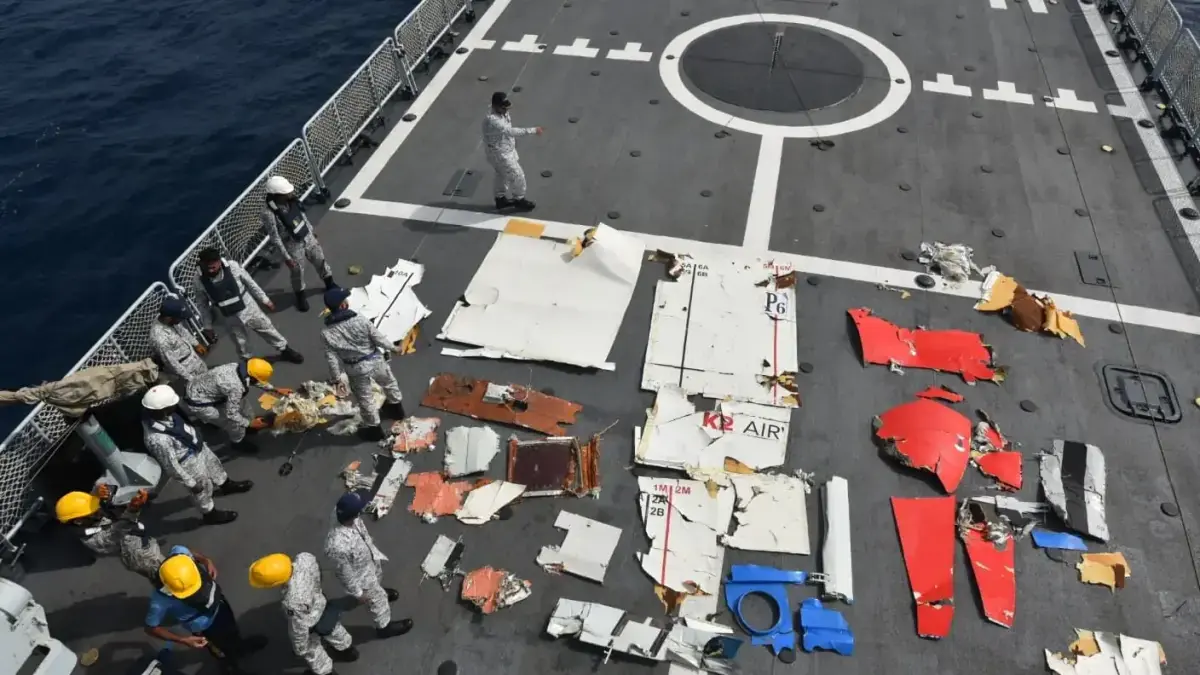
EVERYTHING appeared normal until the crew of K2 Airways Flight 1732, a Boeing 737-400 registered as AP-BOI, reported a navigation systems failure at 9:18pm (0418 UTC) on July 7. While operating a ferry flight from Sharjah to Karachi, the crew requested heading guidance from air traffic control. The aircraft had undergone maintenance in Sharjah prior to departure, indicating that maintenance work had been carried out before the ill-fated flight. Three minutes after the initial distress call, the aircraft began a rapid plunge towards the sea, reaching a descent rate of 22,400 feet per minute, as recorded by Flightradar24 — a rate far exceeding even dual-engine failure scenarios, as commercial aircraft are designed to glide rather than descend like a stone. The crash resulted in the death of all five crew members on board. As findings of any investigation are awaited, IRU failure, spatial disorientation, CRM breakdown are explored among likely causes of crash Captain Muhammad Rizwan Idrees had spent most of his career as a rotary-wing (helicopter) pilot, while First Officer Faisal Jatoi was at the early stage of his airline career. Four speculative causes appear most plausible for such a rapid and catastrophic loss of control: IRU failure coupled with spatial disorientation This remains the leading hypothesis. The crew reported navigation system malfunctions and requested directional guidance from Karachi Area Control. An Inertial Reference Unit (IRU) failure involves a critical malfunction of the Inertial Reference Unit — a core avionics system that uses gyroscopes and accelerometers to provide the aircraft’s attitude (pitch, roll and yaw), position and velocity. When it fails, it can feed corrupt data, or no data at all, to the primary flight displays, autopilot and navigation systems. The reported erratic altitude excursions — a 5,000-foot descent followed by a 6,000-foot climb — loss of airspeed, and the subsequent stall and entry into a graveyard spiral or spin strongly suggest IRU failure combined with spatial disorientation and a catastrophic breakdown in Crew Resource Management. These typical Swiss cheese failures are particularly dangerous over the sea at night in cloudy conditions, with scattered thunderstorms reported up to 41,000 feet. Additionally, more than 20 aircraft reported GPS spoofing along the route and near the crash site. The flight path passed close to an active conflict zone where clashes between Iran and the United States had resumed on the same day. Military activity in such areas poses significant risks to civil aviation, as states do not always issue timely NOTAMs or divert civilian traffic when air defences are activated. A recent example is Azerbaijan Airlines Flight J2 8243, which was struck over Grozny when Russian air defences were active against Ukrainian drones but civilian traffic was neither properly notified nor diverted. In-flight structural break-up A sudden plunge from cruising altitude could occur if the aircraft broke apart in mid-air. However, the initial erratic descent of 5,000 feet, followed by a 6,000-foot climb and a subsequent right turn, suggests the aircraft was still intact at that stage. Excessive g-forces applied during recovery attempts may then have caused a mid-air structural failure. While theoretically possible, this scenario does not fully align with the reported navigation failure unless multiple cascading system failures occurred — again pointing towards Scenario 1. Runaway trim or flight control jamming The sequence of a 5,000-foot descent, a 6,000-foot climb and the final death spiral could indicate runaway trim or control surface jamming. Runaway trim occurs when the elevator trim motor malfunctions, causing uncontrolled nose-up or nose-down movements. However, at high altitude, crews generally have sufficient time to identify the issue and disconnect the trim system. Having personally experienced this emergency, the author considers it unlikely to have caused the total loss of control in this case. Weight and balance A major in-flight shift in the aircraft’s centre of gravity due to unsecured cargo can lead to sudden stalls or unrecoverable attitudes. This scenario can largely be ruled out, as the aircraft was operating a ferry flight with no passengers or cargo. At present, IRU failure combined with spatial disorientation and catastrophic Crew Resource Management failure appears to be the most probable cause. This theory gains further weight when compared with the crash of Adam Air Flight 574 in Indonesia in 2007, which also involved a Boeing 737-400 with a history of repeated IRU malfunctions. On Jan 1, 2007, Adam Air Flight 574, a Boeing 737-400 operating a domestic service from Jakarta to Manado via Surabaya, crashed into the Makassar Strait near Polewali, Sulawesi. All 102 people on board perished in what remains the deadliest accident involving a Boeing 737-400 and the deadliest known crash attributed to IRU malfunction.